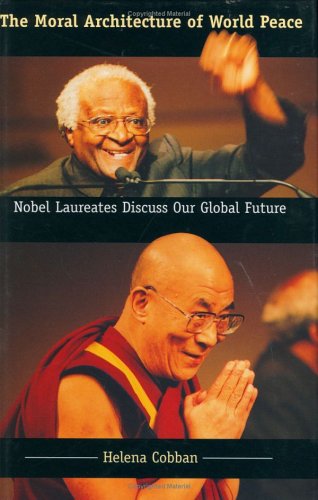
The Moral Architecture of World Peace: Nobel Laureates Discuss Our Global Future (Page-Barbour Lectures) Book PDF, ePub eBook
The Moral Architecture of World Peace: Nobel Laureates Discuss Our Global Future (Page-Barbour Lectures).pdf
File Name: The Moral Architecture of World Peace: Nobel Laureates Discuss Our Global Future (Page-Barbour Lectures).pdf
Size: 19.36 MB
Uploaded: 2017-02-25 01:55:27
Status: AVAILABLE Last checked: 41 Minutes ago!
Rating: ★★★★★ 86 out of 100 based on 20991 user
Book Descriptions:
In November 1998, eight visionary recipients of the Nobel Peace Prize gathered on the grounds of the University of Virginia for two days of extraordinary dialogue. From the words of His Holiness the Dalai Lama to Archbishop Desmond Tutu's riveting description of chairing South Africa's Truth and Reconciliation Commission, their conversation ranged from familiar international-relations issues to areas traditionally excluded from such discourse, like the need for personal transformation and community organizing.
From the laureates' speeches and exchanges, the veteran journalist Helena Cobban has drawn a powerful, prescient vision of our shared global future. Unlike other recent books on global change, The Moral Architecture of World Peace is based on the heroic stories of nine individuals, from as varied backgrounds as Rigoberta Menchú Tum and Jody Williams, who base their view of world peace on personal strength and public activism, not economic trends.
Each chapter contains one laureate's version of a shared message: that peace is grounded in the personal and spiritual as well as the economic and military dimensions of global interconnectedness. When the Dalai Lama speaks of the need for inner as well as external disarmament, he is asking for a greater commitment than the most complicated nuclear arms treaty. Along similar lines, the Northern Ireland peace activist Betty Williams tells of her hope to disarm "the landmines of the heart," the bitterness that lives on in war survivors that can be more destructive than physical scars. Jody Williams and Bobby Muller, 1997 laureates, sound a concordant note in the story of their successful campaign to win an international treaty banning landmines.
Former Costa Rican president Oscar Arias Sánchez, architect of the five-nation peace accord in Central America, challenges citizens of rich western countries to recognize the gap between their luxury spending and the amounts needed to fund basic human services in other parts of the world. Indigenous-rights activist Rigoberta Menchú Tum and East Timorese representative José Ramos-Horta both lament the human and social costs paid by what Ramos-Horta calls, sorrowfully, the world's "expendable peoples." Harn Yawnghwe, speaking on behalf of the Burmese democratic leader Aung San Suu Kyi, who was refused the right to travel by her government, talks of the tough issues of preparing for a transition to postauthoritarian rule in a country that has been run by a military junta.
As Helena Cobban articulates, these leaders all seem to subscribe to a broader set of truths that are not necessarily self-evident: that human beings can easily become locked into self-perpetuating "systems of suspicion and violence" at any level, from the interpersonal through the international; that when one is inside such a system, it can be hard to see it and to recognize one's own role within it; but that each one of us has the capacity to make a leap from self-centeredness toward greater understanding. "Try to change motivation," the Dalai Lama urges.
But while these laureates' stories are primarily of personal and political triumph, they also tell of great sacrifice, conflict, and pain. Bobby Muller's passionate exchange with Archbishop Tutu on moral accountability versus reconciliation, and the self-examination of Ramos-Horta, who reflected that his own East Timorese independence movement may have hurt the chances of United States' intervention to prevent Indonesia's brutal invasion of his country, point toward the new kinds of challenges we face in the next century.
From the candor, eloquence, humor, and differences expressed by these inspiring people, Helena Cobban has sketched out a new international paradigm of peace.
The Moral Architecture of World Peace: Nobel Laureates Discuss Our Global Future (Page-Barbour Lectures) by Helena Cobban
From reader reviews:Ruth Graham:
Book will be written, printed, or descriptive for everything. You can understand everything you want by a publication. Book has a different type. To be sure that book is important point to bring us around the world. Adjacent to that you can your reading ability was fluently. A e-book The Moral Architecture of World Peace: Nobel Laureates Discuss Our Global Future (Page-Barbour Lectures) will make you to always be smarter. You can feel a lot more confidence if you can know about almost everything. But some of you think this open or reading any book make you bored. It is far from make you fun. Why they can be thought like that? Have you trying to find best book or appropriate book with you?
Eleanor Sotomayor:
A lot of people always spent all their free time to vacation or even go to the outside with them friends and family or their friend. Do you know? Many a lot of people spent they will free time just watching TV, as well as playing video games all day long. In order to try to find a new activity honestly, that is look different you can read some sort of book. It is really fun in your case. If you enjoy the book which you read you can spent all day every day to reading a reserve. The book The Moral Architecture of World Peace: Nobel Laureates Discuss Our Global Future (Page-Barbour Lectures) it is rather good to read. There are a lot of those who recommended this book. These people were enjoying reading this book. If you did not have enough space to develop this book you can buy typically the e-book. You can m0ore very easily to read this book through your smart phone. The price is not to cover but this book provides high quality.
Danielle Hawkins:
Playing with family in a park, coming to see the ocean world or hanging out with friends is thing that usually you could have done when you have spare time, and then why you don't try factor that really opposite from that. One activity that make you not experience tired but still relaxing, trilling like on roller coaster you already been ride on and with addition details. Even you love The Moral Architecture of World Peace: Nobel Laureates Discuss Our Global Future (Page-Barbour Lectures), you can enjoy both. It is excellent combination right, you still desire to miss it? What kind of hangout type is it? Oh come on its mind hangout guys. What? Still don't understand it, oh come on its identified as reading friends.
Curt Stewart:
The Moral Architecture of World Peace: Nobel Laureates Discuss Our Global Future (Page-Barbour Lectures) can be one of your nice books that are good idea. All of us recommend that straight away because this book has good vocabulary that can increase your knowledge in vocabulary, easy to understand, bit entertaining but nevertheless delivering the information. The article author giving his/her effort to place every word into delight arrangement in writing The Moral Architecture of World Peace: Nobel Laureates Discuss Our Global Future (Page-Barbour Lectures) although doesn't forget the main stage, giving the reader the hottest as well as based confirm resource data that maybe you can be among it. This great information can easily drawn you into completely new stage of crucial considering.

How it works:
- 1. Register a free 1 month Trial Account.
- 2. Download as many books as you like (Personal use)
- 3. Cancel the membership at any time if not satisfied.
